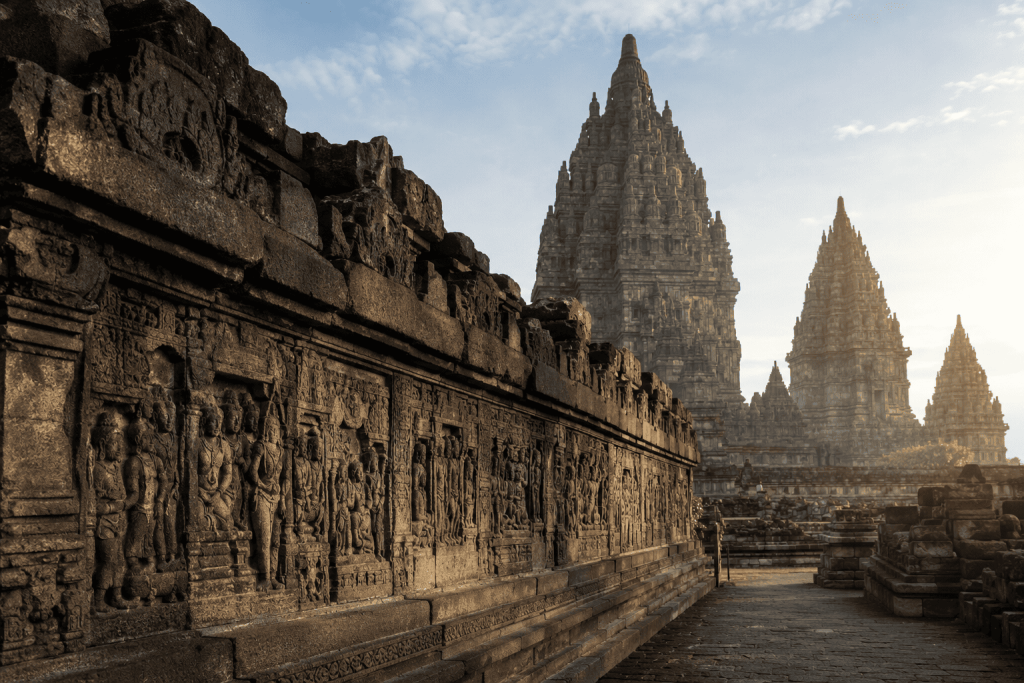
A Prambanan Temple History Guide helps travelers explore the fascinating story behind one of Indonesia’s most remarkable Hindu heritage monuments. Prambanan represents ancient Javanese civilization, religious traditions, and architectural achievements that continue to attract visitors from around the world.
Many travelers visit Prambanan because of its impressive towers and detailed carvings. However, the history behind the temple reveals a deeper story about kingdoms, beliefs, and cultural development in ancient Java.
For travelers aged 25 and above, understanding Prambanan’s history creates a more meaningful journey. The temple allows visitors to connect with the past while experiencing one of Yogyakarta’s most important cultural destinations.
Origin of Prambanan Temple
The Prambanan Temple History Guide begins during the 9th century when the temple complex was constructed in Central Java.
Prambanan was built during the Mataram Kingdom period, a time when Hindu culture developed significantly in Java.
The temple complex was dedicated to the Trimurti, which consists of Shiva, Vishnu, and Brahma.
Among these three temples, the Shiva Temple became the largest and most important structure.
Ancient builders created Prambanan as a center for Hindu worship and religious activities.
Furthermore, the monument reflected the political and cultural achievements of the kingdom that built it.
Travelers can explore more about Prambanan’s history, architecture, and cultural significance through this complete guide to Prambanan Temple and the biggest Hindu temple in Indonesia.
Prambanan During Ancient Javanese Civilization
Prambanan represents the influence of Hindu traditions in ancient Java.
During this period, kingdoms developed impressive architecture, literature, and artistic traditions.
The temple complex became a symbol of religious devotion and cultural advancement.
The detailed carvings found throughout Prambanan provide information about ancient beliefs and storytelling traditions.
Visitors can observe how religion and art were connected through stone architecture.
Additionally, the temple shows the advanced skills of ancient craftsmen who created detailed structures without modern technology.
The Rediscovery of Prambanan
Over centuries, Prambanan experienced changes caused by natural events and historical developments.
Earthquakes and volcanic activity damaged parts of the temple complex.
For many years, the monument received limited attention before researchers began studying and restoring the site.
Restoration efforts helped protect the remaining structures and preserve their historical value.
Today, visitors can experience Prambanan because of continuous conservation programs.
The Importance of Prambanan in Indonesian History
Prambanan holds an important position in Indonesian cultural history.
The temple represents the diversity of religious traditions that developed in ancient Java.
Its existence shows how different civilizations contributed to Indonesia’s cultural identity.
Furthermore, Prambanan provides valuable information about ancient architecture, mythology, and social life.
The monument continues to educate visitors about the achievements of past generations.
Exploring Prambanan Through Historical Stories
A visit to Prambanan becomes more valuable when travelers understand its historical background.
Local guides can explain the stories behind the temple structures, relief panels, and Hindu symbolism.
This explanation helps visitors appreciate details that may be missed during independent exploration.
For travelers who want a comfortable cultural journey, explore professional Yogyakarta tour services with local guides and customized travel experiences.
Explore the Historical Legacy of Prambanan
A Prambanan Temple History Guide reveals how an ancient monument continues to preserve stories from the past.
Prambanan connects history, religion, architecture, and culture in one extraordinary destination.
Plan your Yogyakarta adventure and explore the historical legacy preserved at Prambanan Temple.